LIFTING ENGINEERING APPLICATIONS
Lifting engineering is a fundamental discipline in the design and execution of heavy lifting operations. Its purpose is to ensure safe, efficient and technically controlled lifting activities involving heavy loads or components with complex geometries.
Its applications span a wide range of industries where careful lift planning is essential. These include:
Civil construction
In the construction sector, lifting engineering is used to develop technical studies and lifting plans for the installation of structural steelwork, precast concrete elements, roofing systems, beams and large architectural components. It enables precise coordination of lifting operations on site, reducing risks and improving project efficiency.
Energy industry
The energy sector relies on lifting engineering for the installation of turbines, generators, heat exchangers and other large-scale equipment. Every lifting operation is carefully engineered through load analysis, stability assessments and evaluation of site conditions to ensure safe execution.
Petrochemical industry
Within petrochemical plants, lifting engineering is essential for installing reactors, distillation columns, storage tanks and process equipment. Detailed lift planning is particularly critical due to confined working environments and stringent industrial safety requirements.
Infrastructure
In infrastructure projects, lifting engineering plays a key role in planning and executing the movement and installation of large and heavy structural elements such as bridge sections and viaduct components, ensuring safe, efficient operations tailored to project requirements.
Marine and port industry
The marine and port sector uses lifting engineering for loading and unloading industrial modules, marine engines, cranes, oversized containers and large structures, improving port logistics and shipbuilding operations.
Industrial manufacturing
In manufacturing environments, lifting engineering supports the movement and installation of heavy machinery, production lines, moulds and oversized equipment within factories and assembly plants, ensuring accuracy and operational safety.
Lifting engineering for complex environments
For highly complex projects, lifting engineering incorporates advanced technologies such as 3D simulations, centre of gravity analysis, stability assessments and digital lift planning to maximise operational safety and efficiency.
LIFTING ENGINEERING FOR LARGE-SCALE PROJECTS
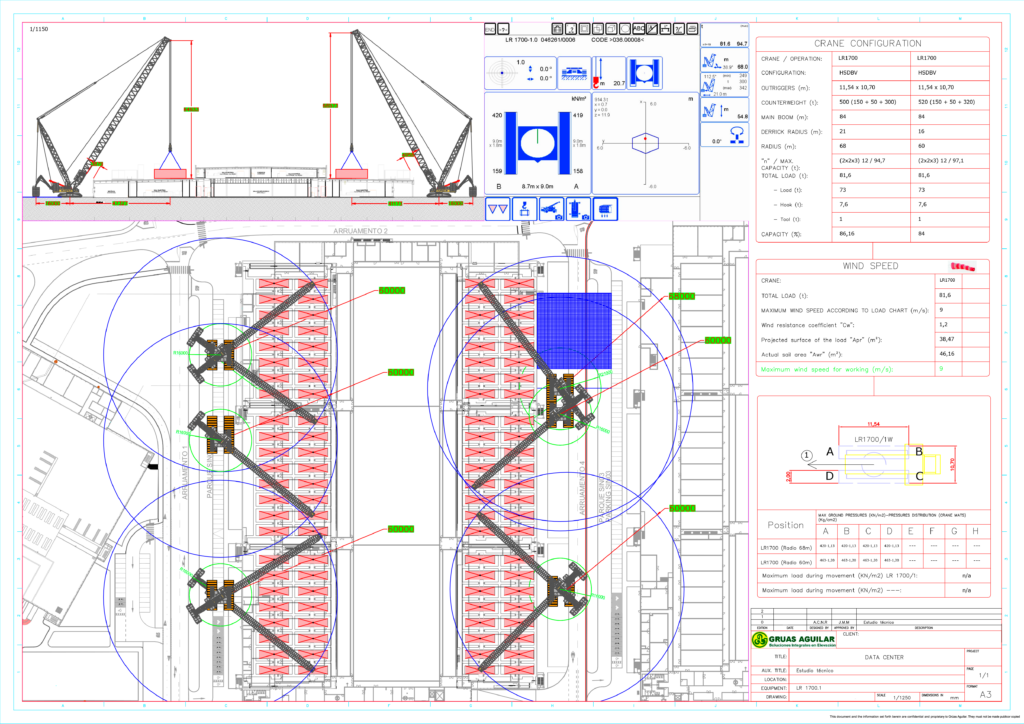
In projects involving exceptionally heavy loads, lifting engineering is a decisive factor in achieving safe and successful operations. This is particularly true in major infrastructure developments, energy projects, large civil engineering works and logistics facilities.
For projects of this scale, detailed lift plans are developed, including structural load analysis, selection of high-capacity cranes, ground bearing assessments and coordination of complex lifting operations across multiple teams.
Accurate planning is essential to prevent delays, minimise downtime and ensure the safety of all personnel involved. Furthermore, effective lifting engineering helps optimise project costs by reducing on-site uncertainties and improving overall logistical efficiency.
This comprehensive approach transforms every lifting operation into a fully controlled, traceable process that complies with international safety standards and engineering best practices.
LIFTING ENGINEERING FOR WIND FARMS
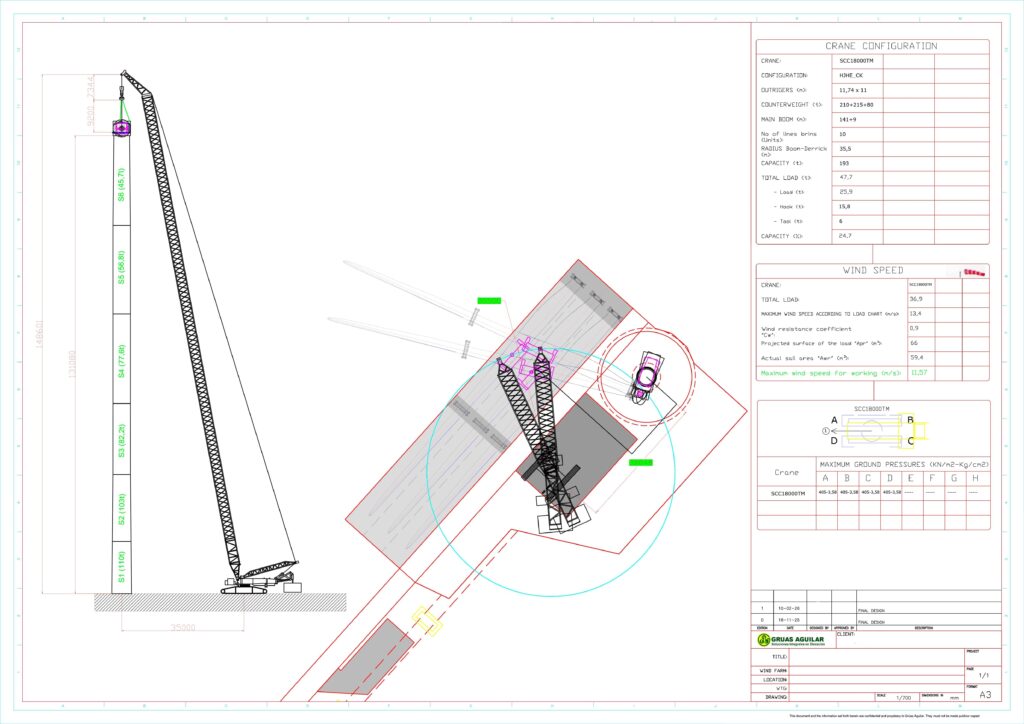
Wind farm construction is one of the sectors where lifting engineering plays its most critical role. The installation of wind turbines involves handling extremely large and heavy components, including tower sections, nacelles and Blades, which require highly specialised lifting operations.
In this industry, lifting engineering focuses on detailed lift planning for each component, weather condition assessments, selection of heavy-lift cranes and the design of logistics routes for transporting oversized loads.
Additional factors such as wind speed, ground stability and available lifting windows are carefully evaluated, as any variation may directly affect the safety and feasibility of the operation.
Through effective lifting engineering, wind farms can be built more safely, efficiently and sustainably, helping accelerate the transition towards renewable energy.