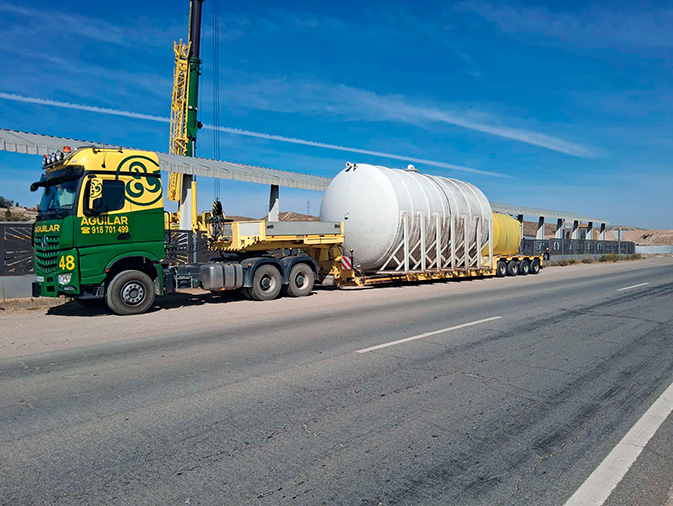
Specialized transport requires meticulous planning to ensure the safety of the cargo, road users, and the transport operation itself. When a load exceeds the dimensions or weight limits established by current regulations, it becomes necessary to design a specific route that takes multiple technical, logistical, and administrative factors into account. So, how is an oversized load route planned?
What is considered an oversized load?
In Spain, an oversized load is any cargo that, once loaded onto a vehicle, exceeds the maximum dimensions or weight limits authorized for standard road transport under the General Vehicle Regulations. A transport operation is generally classified as a special transport or oversized load when it exceeds any of the following limits:
- Width: 2.55 meters (2.60 meters for temperature-controlled vehicles).
- Height: 4.00 meters from the road surface (4.50 meters in certain standard exceptions).
- Length: 16.50 meters for articulated vehicles, 18.75 meters for road trains, and 12 meters for rigid single-unit trucks.
- Maximum Authorized Mass (MAM): 40 tonnes for most freight transport vehicle combinations, although this may vary depending on axle configurations and vehicle specifications.
When a load exceeds any of these dimensions or weight limits, it is classified as a special transport or oversized load. As a result, specific permits are required, and a more comprehensive planning process must be carried out before the transport operation can begin.
How is an oversized load route planned?
Planning a route for an oversized load is a highly technical transport engineering process that begins long before the vehicle starts its journey.
Initial load assessment
The first step is to analyze the exact characteristics of the cargo, including its weight, length, width, height, and support points. These factors determine the type of vehicle and equipment required, as well as the restrictions that may be encountered along the route.
Route analysis
Once the load dimensions have been established, a detailed route survey is conducted. This assessment typically evaluates factors such as:
- Clearance heights of bridges and overpasses.
- Road and access widths.
- Turning radii at intersections and roundabouts.
- Road surface conditions.
- Weight restrictions on bridges and structures.
- Roadworks or temporary traffic disruptions.
Special permit applications
Transporting oversized cargo requires specific permits issued by the relevant authorities. These permits define operating conditions, approved travel schedules, and, in some cases, the requirement for escort vehicles or pilot cars. Managing this administrative process is essential to avoid delays and ensure full regulatory compliance.
Coordination of support resources
Depending on the characteristics of the load, additional resources may need to be coordinated, including:
- Pilot or escort vehicles.
- Police escorts.
- Temporary traffic signage.
- Temporary road closures.
- Temporary removal of road signs or street furniture.
Effective coordination of these resources helps minimize disruption to traffic and ensures safety throughout the entire journey.
Risk assessment and contingency planning
Before the transport operation begins, a comprehensive risk assessment is carried out to identify potential challenges and establish response protocols. Alternative plans are also developed to address unforeseen situations such as adverse weather conditions, accidents, or temporary traffic restrictions.
Monitoring during transport
During the execution of the special transport operation, logistics teams continuously monitor the route to ensure that all planned conditions are met and to respond quickly to any incidents that may arise.
Proper route planning is essential for the success of any oversized load transport project. By carefully analyzing the route, obtaining the necessary permits, and coordinating all required resources, companies can reduce risks, avoid delays, and ensure that cargo reaches its destination safely and efficiently.
Working with a specialist heavy haulage and oversized transport company such as Aguilar provides the expertise needed to manage complex logistics projects successfully while ensuring full compliance with all applicable regulations.